

What is a Self Lubricating Bearings? How is it Different from a Sintered Oil Impregnated Bearings?
In modern industrial automation and precision equipment, self lubricating bearings and sintered oil-impregnated bearings are frequently mentioned.
Although they share many functional similarities, they differ in technical details, application scenarios,and material choices. JINWOEN, as a professional powder metallurgy manufacturer,will provide an in-depth comparison to help you make the best choice.
What is a Self Lubricating Bearings?A self-lubricating bearings is a bearing with automatic lubrication properties.
Its core design features an internal porous structure capable of storing lubricants (such as oil or solid lubricants).
During operation, the lubricant is automatically released, reducing friction and wear, ensuring stable equipment performance.
Key Features of Self Lubricating Bearings:
- Maintenance-Free Design: No need for frequent lubrication, reducing maintenance costs.
- High Stability: Maintains stable performance under high load and prolonged operation.
- Eco-Friendly and Energy-Saving: Reduces lubricant usage, minimizing resource consumption.
- Low Friction Coefficient: Provides smooth motion and minimizes mechanical wear.
- Automotive Components (e.g., engines, transmission systems)
- Industrial Machinery Equipment
- Home Appliances (e.g., fan motors)
- Precision Instruments
JINWOEN's self lubricating bearings, manufactured using advanced powder metallurgy technology, deliver efficient self-lubricating performance, making them an ideal choice for various precision equipment and automation systems.
What is a Sintered Oil-Impregnated Bearing?A sintered oil-impregnated bearing is a type of self-lubricating bearing primarily manufactured using powder metallurgy technology. Metal powders are compacted, sintered at high temperatures, and then immersed in lubricating oil, allowing the oil to evenly penetrate the porous structure.
Key Features of Sintered Oil-Impregnated Bearings:
- High Porosity: Effectively stores lubricating oil for long-term lubrication.
- Stable Release: Oil is automatically released during operation with changes in temperature and pressure.
- High Wear Resistance: Suitable for medium-to-low speed and medium-to-low load applications.
- Low Noise: Provides a quiet and stable operating environment.
- Micro Motors
- Electronic Devices
- Household Appliances (e.g., electric fans, washing machines)
- Industrial Automation Equipment
JINWOEN's sintered oil-impregnated bearings, made from CZ-1000 material, undergo precise sintering and oil immersion processes to ensure exceptional self-lubricating performance and stability.
Differences Between Self-Lubricating and Sintered Oil-Impregnated Bearings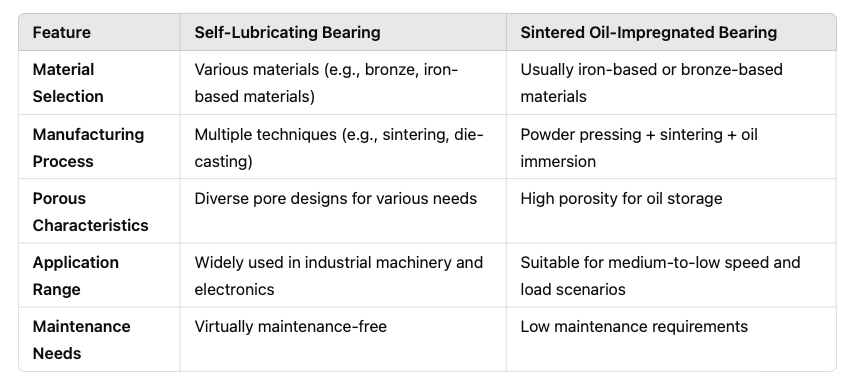
- Operating Environment: High temperature, high speed, low temperature, or heavy load conditions.
- Lubrication Needs: Regular maintenance or completely maintenance-free operation.
- Cost Considerations: Long-term operational cost efficiency.
- Application Scenarios: Industrial equipment, home appliances, automotive, or electronic devices.
JINWOEN with over 30 years of experience in powder metallurgy technology, offers customized self-lubricating and sintered oil-impregnated bearing solutions, ensuring optimal performance across various applications.
Why Choose JINWOEN?- Professional Expertise: Over 30 years of experience in powder metallurgy.
- Quality Assurance: Certified under ISO9001 international standards.
- Custom Design: Precision designs tailored to customer requirements.
- Stable Supply Chain: Reliable production and supply capacity.
Whether it’s a self-lubricating bearing or a sintered oil-impregnated bearing, JINWOEN delivers efficient and reliable products, ensuring stable operation, reduced maintenance costs, and enhanced performance.
Contact us today for professional consultation and customized solutions!